
ECI Informs Supreme Court: Fraudulent Voter Deletion Forms Rejected in Uttar Pradesh
ECI Responds to Allegations of Electoral Fraud
The Election Commission of India (ECI) informed the Supreme Court on Friday that while "false" Form 7s for the deletion of voters were detected during the Uttar Pradesh Special Intensive Revision (SIR), none of these fraudulent requests were accepted. The ECI made this submission in response to a petition filed by Congress leader and Barabanki MP Tanuj Punia. Represented by senior advocate Salman Khurshid and advocate Shariq Ahmed, the petitioner alleged widespread misuse and fraud regarding the bulk filing of Form 7s during the claims-and-objections phase of the Uttar Pradesh SIR.
Prompt Corrective Measures Taken
Appearing before a Supreme Court Bench headed by Chief Justice of India Surya Kant, senior advocate Dama Seshadri Naidu, representing the ECI, stated that corrective measures were implemented promptly upon the discovery of the fraudulent submissions. The commission emphasized that local authorities actively rejected all Form 7 submissions that violated established statutory norms, preventing any unauthorized removals from the electoral roll.
Understanding Form 7 and Electoral Rules
Form 7 is the prescribed statutory format under the Registration of Electors Rules, 1960, which are framed under the Representation of the People Act, 1950. According to Section 13(2) of these rules, any objection to the inclusion of a name in the electoral roll must be submitted using Form 7. Crucially, the rule mandates that such objections can only be preferred by a individual whose name is already included in that specific electoral roll.
Voters can utilize Form 7 to object to an entry based on specific legal grounds, including:
- The death of a registered voter
- Duplication of a name within the roll
- Shifting of residence to a different constituency
- Ineligibility due to age, citizenship status, or misrepresentation
Regulatory Shifts and Oversight Mechanisms
Prior to recent amendments, only individuals registered at the exact same booth or polling station were permitted to file a Form 7 objection. However, in 2022, the Election Commission of India amended the relevant rules to allow any registered voter within a constituency to file an objection, significantly widening the ambit of who can challenge voter inclusions. To prevent potential misuse arising from this expanded eligibility, the Electoral Registration Officer (ERO) is legally required to mandate strict verification protocols before acting on any deletion request.
World Bank Report: India Achieves Remarkable Poverty Reduction Over Last Decade
Massive Decline in Monetary Poverty Rates
India has made remarkable progress in reducing poverty across both monetary and non-monetary dimensions over the last decade, securing one of the fastest poverty reduction rates in the world. According to the World Bank's October 2026 Poverty and Equity Brief for India, the share of the population living below the Lower Middle-Income Country line of 4.2 dollars per day plummeted from 57.7% in 2011 to 16.1% in 2023. This significant shift successfully lifted an estimated 496 million people out of poverty. Concurrently, extreme poverty, measured at 3.00 dollars per day, experienced a steep decline from 27.1% to 2.6% over the same period. The World Bank projects that poverty will continue to decline moving forward, though at a more gradual pace.
Sharp Drops in Multidimensional Poverty
The progress extends to non-monetary dimensions of poverty as measured by the Multidimensional Poverty Index (MPI) from the Oxford Poverty and Human Development Initiative (OPHI). Multidimensional poverty in India fell sharply from 53.8% in 2005–06 to 16.4% in 2019–21. Furthermore, the World Bank’s own MPI measure recorded a continued drop to 15.5% in the 2022–23 period, underscoring broad improvements in living standards across the nation.
Persistent Disparities and Geographical Concentration
Despite these historic gains, the report highlights that wage disparities remain highly pronounced. In 2023, the median earnings among the top 10% of workers were roughly 13 times higher than those of the bottom 10%. Additionally, poverty has become increasingly concentrated in specific regions. While overall living standards improved across most states, a contiguous geographical belt stretching from Uttar Pradesh to West Bengal now accounts for 57% of India’s entire poor population.
Job Growth Driven by Rural Women Amid Rising Youth Unemployment
On the employment front, India saw a massive surge between 2017 and 2023, with total employment increasing by about 134 million people. This expansion was nearly twice the growth rate of the working-age population, largely driven by rural women entering paid work and increasing the total number of earners per household. However, challenges persist for younger demographics. The World Bank highlighted that youth unemployment climbed from 14.6% to 15.9% between the first quarter of financial year 2026 and the first quarter of financial year 2027, with the increase being particularly pronounced among rural young women.
ISRO Successfully Launches NVS-03 Navigation Satellite Aboard GSLV-F18
Successful Liftoff from Sriharikota
The Indian Space Research Organisation (ISRO) successfully launched the NVS-03 satellite late on Friday using the Geosynchronous Satellite Launch Vehicle (GSLV-F18). Lifting off from the second launch pad at the Satish Dhawan Space Centre in Sriharikota, the GSLV-F18 placed the 2,250 kg satellite into its intended geosynchronous transfer orbit approximately 18 minutes after launch. The mission marks a crucial step forward for India's space program, serving as ISRO’s third mission of 2026, following the failed PSLV-C62 launch in January and the successful GSLV-F17 mission in September.
Restoring the NavIC Constellation
The NVS-03 is the third satellite in India's next-generation navigation satellite system. It is designed to provide continuity of navigation services for the Indian Regional Navigation Satellite System (IRNSS) series, commercially known as Navigation with Indian Constellation (NavIC). With an expected mission life of 12 years, this launch is poised to restore the functioning of the NavIC constellation. The network had been significantly weakened by repeated failures of imported atomic clocks—including the stoppage of the last functioning clock aboard IRNSS-1F on March 13 earlier this year—and the failure to place the previous replacement satellite, NVS-02, into its operational orbit in 2025.
Advanced Features and Indigenous Technology
A standout feature of the NVS-03 is its payload, which carries an indigenous Rubidium atomic clock developed by the Space Applications Centre (SAC) in Ahmedabad alongside procured atomic clocks. This homegrown timing technology was specifically developed to resolve the vulnerability issues caused by the failure of imported atomic clocks in first-generation satellites.
Additionally, the satellite introduces the civilian L1-band signal to supplement the existing L5 and S bands. The inclusion of the L1 band enables interoperability with global systems like GPS and allows the navigation data to be directly compatible with modern, low-power commercial platforms such as smartphones, smartwatches, and fitness trackers.
NavIC Service Architecture and Capabilities
NavIC operates across three core segments: the Space Segment consisting of the navigation satellites, the Ground Segment managing control and timing infrastructure, and the User Segment involving various receiver types. The system provides two primary classes of service: the Standard Positioning Service (SPS) for civilian users and an encrypted Restricted Service (RS) dedicated to authorized strategic and defence applications. The primary service area encompasses the entire Indian landmass and extends approximately 1,500 km beyond the nation's geopolitical boundaries.
Evolution of the Indian Navigation System
The deployment of the NVS series represents the second generation of India's regional positioning infrastructure. The first generation, comprising the IRNSS-1 series (1A through 1G), was launched between 2013 and 2018 with a 10-year mission life. That initial phase faced setbacks, including the launch failure of IRNSS-1H in 2017 due to a heat shield separation issue, which was later remedied by the launch of IRNSS-1I in 2018. As the first-generation satellites near the end of their operational lifespans, the upgraded NVS series—which began with the successful launch of NVS-01 in 2023—seeks to reinforce the constellation, with NVS-04 and NVS-05 planned for future deployment.
Managed Coexistence: Visualizing the Complex State of Contemporary India-China Relations
A Framework of Managed Coexistence
The state of relations between China and India today can best be described as a framework of managed coexistence. While bilateral ties remain complex and heavily scrutinized, it is far-fetched to believe that India is China's primary opponent or that a conflict between the two nuclear-armed neighbours is either inevitable or imminent. Instead, both nations possess the strategic capacity to coexist peacefully with one another.
Historical Context and Border Complexities
To understand modern friction, historians often look back to the 1962 Sino-Indian conflict. It can be argued that this clash was an outcome of Mao Zedong's hubris in the wake of his disastrous Great Leap Forward, though analysts adduce several other systemic reasons for the outbreak of war.
Chief among the lingering structural challenges is the improperly delineated terrain. In the western sector, Ladakh’s ambiguous topography is frequently cited as a major obstacle preventing a permanent boundary solution. Similarly, in the eastern sector of Arunachal Pradesh, tensions are exacerbated by the legacy of an improperly demarcated border. In this region, the historical McMahon Line itself acts as a source of persistent diplomatic and military friction alongside Chinese assertions.
Geopolitical Pressures and Military Realities
Extraneous geopolitical aspects have further contributed to the perseverance of the current diplomatic stalemate. The U.S.-sponsored QUAD (Quadrilateral Security Dialogue) initiative, for instance, introduces external balancing dynamics into the regional equation.
Furthermore, a critical question remains regarding how well India—and the rest of the international community—understands the true extent of China’s military strength, particularly its capability to win modern and future wars. China has achieved a significant accretion of long-range missiles, submarines, advanced surveillance systems, and an impressive amphibious ability. Despite these rapidly expanding Chinese military capabilities, India remains more than a match for China along the high Himalayas, maintaining a robust defensive posture that reinforces the state of managed coexistence.
Chola-Era Bronze Idols of Lord Nataraja and Goddess Sivagami Unearthed in Nagapattinam
Significant Archaeological Discovery in Tamil Nadu
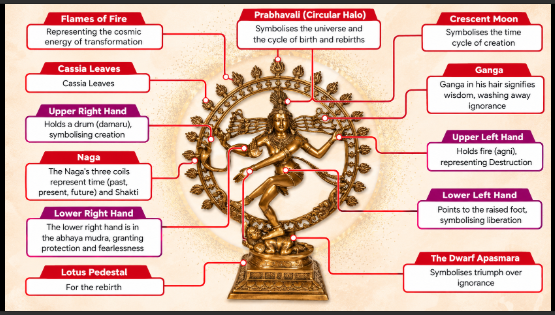
The Tamil Nadu State Department of Archaeology (TNSDA) has unearthed rare bronze alloy idols of Lord Nataraja and Goddess Sivagami during its ongoing excavations in Nagapattinam. Discovered at a depth of just one metre, the idols were found alongside their respective pedestals. These artifacts are estimated to date back to the 12th century AD, providing crucial archaeological evidence for understanding the religious practices, artistic traditions, and history of metal sculptures in the Nagapattinam region during the height of the Chola period.
Iconographic Features and Physical Structure
The two idols display the intricate craftsmanship characteristic of the Chola era, identifiable through their distinct physical structures, iconographic features, and ornamental designs. The idol of Lord Nataraja is depicted in the traditional ‘Ananda Tandava’ cosmic dance posture, featuring four arms and measuring 110 cm in height and 100 cm in width. The accompanying idol of Goddess Sivagami stands in the elegant ‘Tribhanga’ or triple-bent posture, featuring two arms and measuring 82 cm in height and 23 cm in width.
Historical Significance and Official Response
The discovery has been hailed as a major milestone in documenting regional heritage. Sharing the announcement in a post on X, Minister for School Education Rajmohan, who also holds the state's Archaeology portfolio, stated that the findings provide profound evidence of the antiquity and deep historical significance of the Tamil people. The state culture department intends to conduct further structural analyses on the bronze alloys to glean deeper insights into 12th-century metallurgical techniques.
UNEP Recognises India’s Ganges River Dolphin Recovery Program as World Restoration Flagship
Global Recognition for Indian Conservation Efforts
The United Nations Environment Programme (UNEP) has officially recognised India’s Ganges River dolphin species recovery program as one of 35 UN World Restoration Flagships in its recent report, “Nature’s Comeback – Scaling Ecosystem Restoration for People and Planet.” The recognition highlights the success of India's targeted conservation initiatives for this critical marine mammal. According to the first nationwide survey conducted under Project Dolphin in 2020, India is home to 6,327 river dolphins. This population includes 6,324 Gangetic dolphins alongside 3 Indus river dolphins recorded in the Beas River.
Ecological Profile and Habitat
Officially discovered in 1801 and popularly referred to as the "Tiger of the Ganges," the Ganges River dolphin is an obligate freshwater cetacean. It serves as India’s National Aquatic Animal and holds the status of state aquatic animal of Assam. Locally, it is often called "Susu" due to the distinct sound it makes while breathing. The species is strictly restricted to deep-water pools, river bends, and confluence zones across the freshwater reaches of the Ganges–Brahmaputra–Meghna and Karnaphuli–Sangu river systems, spanning India, Nepal, and Bangladesh.
Unique Biological Adaptations
As a flagship freshwater species, the presence of the Ganges River dolphin serves as a critical indicator of riverine health, reflecting suitable river habitats, adequate water availability, and robust prey diversity. The mammal has evolved unique traits to survive in turbid river environments:
- Ultrasonic Echolocation: Functionally blind with poorly developed eyesight, the dolphin relies entirely on ultrasonic clicks and echoes to navigate, locate prey, and detect obstacles.
- Side-Swimming Locomotion: A flexible neck, broad flippers, and an elongated snout facilitate sideways swimming near riverbeds, allowing it to capture bottom-dwelling fish and crustaceans.
- Surface-Breathing Pattern: Being an air-breathing mammal, it periodically surfaces every 30 to 120 seconds to inhale atmospheric oxygen through a blowhole situated atop its head.
Legal Protection and Conservation Status
Due to severe environmental pressures, the Ganges River dolphin is designated as Endangered on the IUCN Red List. To ensure its survival, it has been granted the highest levels of legal protection. It is placed under Schedule I of India’s Wildlife (Protection) Act, 1972, and is listed in Appendix I of the Convention on International Trade in Endangered Species of Wild Fauna and Flora (CITES), which strictly prohibits international commercial trade of the species.
The Algorithmic Pivot: How Software and AI are Remaking the U.S. Military Industrial Complex
The Shift in Global Defence Industrial Foundations
The core of the United States Military Industrial Complex (MIC) is undergoing a fundamental shift away from traditional hardware manufacturers toward algorithm and artificial intelligence companies. This transition is poised to trigger an inevitable fallout across the global defence industrial base. The structural evolution is driven by three interlocking attributes: the inversion of war economics, the complete restructuring of procurement and capital logic, and the comprehensive "software-defined" transformation of the military technology stack.
The White House Accord and High-Level Military Integration
This paradigm shift was formally sanctified on September 29, 2026, when U.S. President Donald Trump convened the chief executive officers of the world's most powerful AI companies to sign the White House Accord on Super Intelligence. This voluntary framework symbolically integrated AI firms directly into the national security architecture.
Beyond symbolism, substantive operational developments had already occurred months earlier. In May 2026, the U.S. Department of War announced agreements with eight prominent technology companies—SpaceX, OpenAI, Google, Nvidia, Reflection, Microsoft, Amazon Web Services, and Oracle. These pacts authorised the deployment of their technical capabilities on classified networks at impact levels 6 and 7, which represent the highest classification tiers for sensitive military operations.
Anatomy of the Algorithmic Military Stack
The May 2026 agreements laid out the specific functional layers that constitute the modern algorithmic military stack. Each company serves a distinct component within this national security ecosystem:
- The Intelligence and Model Layer: Functioning as the brain of the operation, this layer incorporates OpenAI for multilingual intelligence analysis, Google for automated satellite imagery target recognition, and Reflection AI for deploying autonomous combat agents.
- The Compute Layer: Driven by Nvidia's military-grade GPU clusters to process vast amounts of battlefield data.
- The Cloud Services Layer: Built and maintained by Microsoft, Amazon Web Services, and Oracle to manage secure storage and data distribution.
- The Communications and Execution Layer: Powered by SpaceX’s Starlink and Starshield networks, while specialized defence tech firms Palantir and Anduril serve as strategic hubs and frontline execution terminals managing edge AI, drone swarms, and counter-drone systems.
The Rise of Software-Defined Warfare
The core thesis of this new era is "software-defined warfare," where code rather than the physical platform has become the decisive battlefield differentiator. Under this model, a warship’s systems can become significantly smarter overnight through a single software download, and deployed drones can instantly switch their utility from reconnaissance to electronic attack simply by loading a different software package.
While traditional legacy contractors like Lockheed Martin, RTX, and Northrop Grumman have by no means disappeared—continuing to secure the vast majority of defence budget dollars and maintaining superior lobbying expenditures—the symbolic and financial indicators have reversed. Capital market valuations now clearly reflect investors’ forward-looking judgment regarding the future software-centric shape of the global military industrial complex.
Union Government Allocates Social Security Boards for Unorganised and Gig Workers Amid Centralisation Concerns
Step Toward Welfare Reform
One year after the implementation of the Code on Social Security, the Union Labour Ministry has officially constituted the National Social Security Board for Unorganised Workers and the National Social Security Board for Gig and Platform Workers. While the constitution of these bodies is a welcome step toward standardising welfare, the highly centralised architecture of the mechanism raises concerns about whether it can achieve its optimal outcomes.
Structural Breakdown and Governance Architecture
By design, the Union Government retains strict institutional control over both entities. Union Minister for Labour and Employment Mansukh Mandaviya will chair both boards, with the Union Labour Secretary serving as the vice-chairman. The Union Government will also prescribe the specific rules of procedure, mandating that the boards meet at least thrice a year to design, monitor, and recommend targeted welfare schemes. The composition of the two bodies is structured as follows:
- Board for Unorganised Sector Workers: Comprises 40 members nominated entirely by the Union Government. This includes seven members representing unorganised sector workers and seven members representing employers within the unorganised sector.
- Board for Gig and Platform Workers: Comprises 22 members, featuring five representatives nominated from aggregator companies and five from the platform workforce.
Federalism and Representation Deficits
Critics point out that despite including select representatives from central and state governments, prominent aggregator companies, employers, civil society, and unions, the boards lack significant representation from Central Trade Unions aligned with the Opposition, as well as from Opposition-ruled State Governments. Because labour falls under the Concurrent List of the Indian Constitution, both state and central administrations must work collaboratively to improve working conditions. Critics argue that omitting diverse political and regional voices shifts the balance away from cooperative federalism.
Furthermore, these structural friction points echo a report prepared by Justice V. Gopala Gowda for the Kerala Government in March this year. The report flagged distinct anti-federal and anti-worker characteristics within the overarching Social Security Code and formally suggested legislative amendments.
The Gap in Universal Coverage Realities
The International Labour Organization defines social security as the protection a society provides to individuals and households to ensure access to healthcare and guarantee income security—particularly during old age, unemployment, sickness, invalidity, work injury, maternity, or the loss of a breadwinner. The Union Government claims that India's broad social security coverage has expanded significantly, rising from 19% in 2015 to 64.3% in 2025, encapsulating around 94 crore citizens.
However, analysts observe that unorganised, gig, and platform workers—who collectively constitute more than 92% of the country’s total workforce—are still far from enjoying comprehensive social security under the global definition. Almost two decades ago, the National Commission for Enterprises in the Unorganised Sector, led by economist Arjun Sengupta, recommended a comprehensive slew of measures to bridge these exact gaps for the informal sector. The structural vulnerabilities highlighted by the Sengupta panel remain largely unaddressed, leaving the newly formed boards with the monumental task of translating administrative framework into tangible grassroots security.