

Disturbed LAC Patrolling Behaviour Prompts Fresh Diplomatic Tension and Structural Oversight
Disturbances Along the Arunachal Frontier
The Line of Actual Control has been disturbed by the Chinese People’s Liberation Army’s aggressive patrolling behaviour, the Ministry of External Affairs confirmed on Friday. The official statement came in response to questions surrounding reports of fresh military skirmishes along the LAC in Arunachal Pradesh. The underlying border friction came to light via disclosures from the outgoing Director-General of the Indo-Tibetan Border Police Forces, Shatrujeet Kapur, who expressed grave institutional concern over ongoing tactical face-offs that have been underway since July 2026. The revelation of these fresh confrontations has triggered sharp political criticism against the Centre from opposition parties.
Bilateral Ties Tied to Border Peace
In light of the recent face-offs, the MEA reiterated India's firm diplomatic position maintained since the beginning of the four-year military standoff at the LAC, which included the deadly Galwan clashes in 2020. The government re-emphasized that the maintenance of absolute peace and tranquility in the immediate border areas remains an essential prerequisite for the overall development of bilateral relations between New Delhi and Beijing. Diplomatic channels confirmed that both sides remain in constant touch to improve their mutual understanding of the LAC to achieve better, more predictable border management.
The Mechanics of the Disputed Border
India shares a massive boundary of approximately 4,050 km with China, though the actively disputed segments add up to around 3,290 km. The frontier is structurally divided across three distinct sectors:
- Western Side (Ladakh Region): A border of about 2,150 km separates the region from China's Xinjiang province, encompassing the heavily contested Aksai Chin territory.
- Middle Side (Himachal Pradesh and Uttarakhand): Comprising a 625-km boundary, this remains the least controversial sector along the frontier.
- Eastern Side (Sikkim and Arunachal Pradesh): Features around 1,140 km of disputed boundary along Arunachal Pradesh—a region where China routinely claims territorial parts—alongside the critical Doklam tri-junction involving Bhutan, India, and China.
The Legacy and Mandate of the ITBP
Tasked with holding the front line against these incursions is the Indo-Tibetan Border Police, a highly specialized Central Armed Police Force functioning directly under the Ministry of Home Affairs. The elite force holds a deep historical connection to this frontier, having been raised on October 24, 1962, during the height of the historic India-China War. Operating under the official motto of "Shaurya-Dridhata-Karma Nishtha" (Valour-Determination-Devotion to Duty), the force specializes in high-altitude deployment and extreme weather combat operations.
The administrative footprint of the force expanded significantly following the government's strategic "One Border One Force" directive in 2004. Under this recommendation, the entire 3,488 km India-China border—stretching seamlessly from the Karakoram Pass in Ladakh all the way to Jachep La in Arunachal Pradesh—was officially assigned to the ITBP. This consolidation saw the ITBP take over historical border guarding duties from the Assam Rifles in Sikkim and Arunachal Pradesh, establishing a singular, unified command structure to counter border violations.
Government Proposes Comprehensive Overhaul of India's Periodic Labour Force Survey Framework
Tracking the Emerging Digital Economy
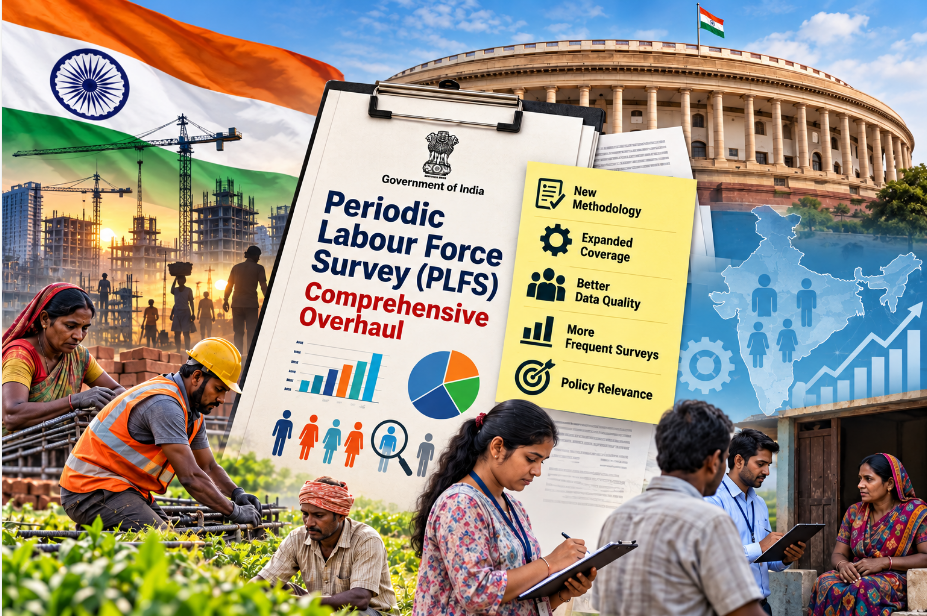
The Union government has decided to change the design and structure of the Periodic Labour Force Survey (PLFS) to track digital platform workers and capture engagement in unpaid household, caregiving, volunteer, and trainee work. The National Sample Survey Office (NSSO), operating under the Ministry of Statistics and Programme Implementation (MoSPI), issued a comprehensive press release and concept note introducing these proposed structural changes. The new survey schedule and revamped design are slated for formal implementation starting January 2027. To facilitate collaborative policymaking, the ministry has invited formal feedback, comments, and suggestions from researchers, academic institutions, and the general public within a strict 15-day window.
Introduction of the Second Stage Stratum
The primary structural reform involves rectifying past data-collection gaps, as experience from the previous survey cycles demonstrated that standard sampling arrangements failed to identify an adequate number of gig and platform professionals. To resolve this, a dedicated Second Stage Stratum (SSS) will be introduced into the PLFS methodology to explicitly identify households containing at least one digital platform worker. An additional yes-or-no filtering question will be integrated into the standard survey questionnaire across both rural and urban households to establish whether any member has engaged in digital platform work during the designated reference period.
Measuring Unpaid Labour and Underutilisation
Beyond tracking the gig economy, the updated PLFS will incorporate specialized, additional questions meticulously designed to measure overall labour underutilisation. For the first time, the official framework will systematically isolate and measure unpaid human resource contributions that historically remained hidden or unquantified in domestic data. These include:
- Unpaid Household Work: Essential domestic chores like cooking and cleaning.
- Caregiving Activities: Time spent caring for children, elderly, sick, or disabled family members.
- Volunteer Commitments: Non-remunerative work performed for community or social benefit.
- Trainee Roles: Unpaid technical or professional learning periods.
While these activities contribute heavily to societal well-being and allow other household members to pursue formal employment, their exclusion from past surveys created statistical blind spots that this revamp seeks to permanently eliminate.
Understanding India's Definitive Labour Metrics
First launched in April 2017 by the National Statistical Office (NSO), the PLFS serves as India’s official, definitive framework for tracking employment and unemployment dynamics. The survey evaluates the health of the Indian labor market through three core macroeconomic formulas:
- Labour Force Participation Rate (LFPR): Compares the total active labor force (both the employed and those actively looking for jobs) against the broader population baseline.
LFPR = ((Number of Employed + Number of Unemployed) / Total Population) * 100 - Worker Population Ratio (WPR): Evaluates the exact employment footprint by calculating the percentage of actively employed individuals within the absolute population.
WPR = (Number of Employed Persons / Total Population) * 100 - Unemployment Rate (UR): Measures the exact ratio of joblessness specifically within the economically active labor pool, filtering out those who are not looking for employment.
UR = (Number of Unemployed Persons / (Number of Employed + Number of Unemployed)) * 100
Government Upgrades Rural Employment Attendance System with AI to Combat Fraud
AI-Based Security Features to Protect Wages
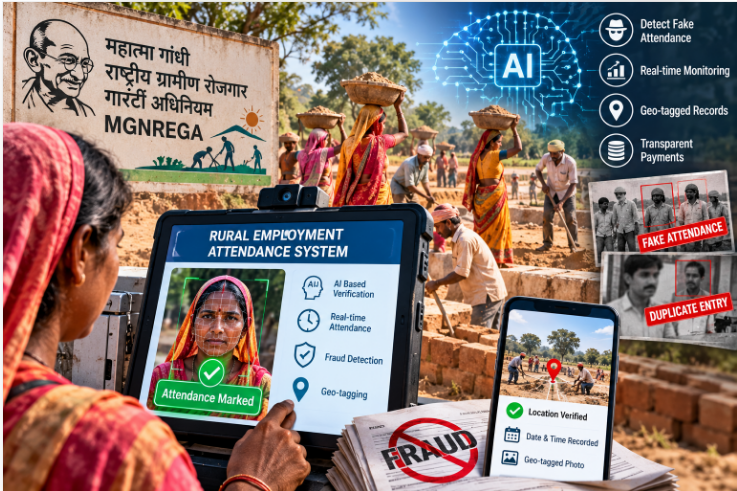
Union Rural Development Minister Shivraj Singh Chouhan announced the launch of an upgraded version of the mobile-based attendance application for the rural employment programme, Viksit Bharat Guarantee for Rozgar and Ajeevika Mission Gramin (VB-GRAM G). The upgraded software integrates artificial intelligence-based verification and advanced security controls explicitly designed to plug operational gaps, prevent tampering, and eliminate fraudulent attendance entries. Chouhan emphasized that the government's primary administrative priority is to protect workers' wages while ensuring that public development funds are utilized transparently for their intended purposes.
Systemic Glitches and Attendance Misuse
The introduction of advanced AI tools follows the exploitation of previous monitoring frameworks. Although face authentication was integrated into the National Mobile Monitoring System in March 2026 to curb fake entries under the legacy MGNREGA scheme, severe discrepancies persisted.
Investigations revealed several high-profile issues on the ground:
- Static Photo Spoofing: Senders frequently used photo-to-photo capturing of physical printouts instead of uploading live, real-time images of workers at active worksites.
- Muster Roll Duplication: The exact same photograph of workers appeared across multiple separate muster rolls.
- Temporal Mismatches: Substantial discrepancies emerged between worker counts and facial identities recorded between morning and afternoon shifts.
- Demographic Anomalies: Field audits detected unexplained mismatches in the gender composition of physical laborers versus the numbers recorded on the application.
The Multi-Layered Verification System
To counter these tracking failures, the Ministry of Rural Development has institutionalized a multi-layered verification framework. The system operates an AI-based photo de-duplication module that systematically scans and identifies suspicious or repeated images.
If the module flags a fraudulent or duplicate entry, the platform automatically withholds the corresponding wage list and Fund Transfer Order (FTO). These payments remain frozen until field authorities complete necessary physical verifications.
Accessibility and Offline Exceptions
Addressing geographical challenges, Chouhan clarified that the system includes built-in operational flexibilities. At worksites located in shadow zones where network connectivity is completely unavailable, attendance can be recorded offline and synced later. Furthermore, an authorized exception mechanism is available to prevent genuine workers from losing their wages when face authentication fails due to structural changes in elderly workers, physical changes in persons with disabilities, or sudden technical problems with the mobile device.
The Legacy of the NMMS Platform
The upgraded software builds upon the foundations of the National Mobile Monitoring Software (NMMS) App, which was originally launched by the Ministry in 2021. Designed to bring transparency and enhance citizen oversight, the app mandated taking real-time attendance at worksites alongside geo-tagged photographs.
Despite its goals, the historical NMMS framework faced severe operational headwinds:
- Low Device Engagement: Ministry statistics revealed that only 25.9% of registered devices were actively used to record daily attendance.
- Gram Panchayat Inactivity: A substantial 41.3% of Gram Panchayats reported zero NMMS device usage.
- Financial Burden: Poor internet connectivity, frequent application glitches, and lack of smartphone access plagued the program, often forcing low-income workers to purchase smartphones out of their own wages without any financial support from the government.
Indian Community Caught in Crossfire as Saudi-Houthi Conflict Escalates Rapidly
Tragic Casualties in a Worsening War
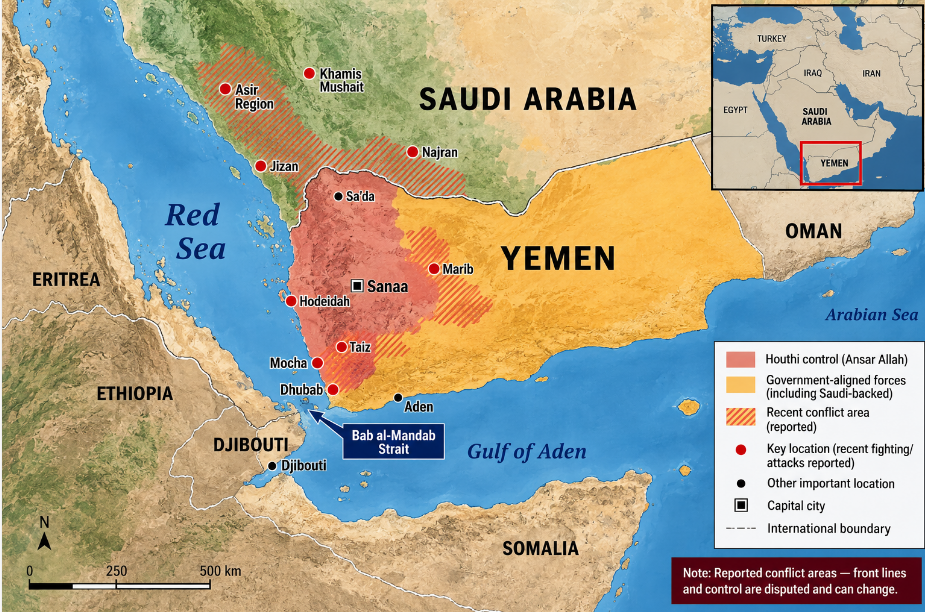
The killing of an Indian national in a Houthi attack on Saudi Arabia’s Dammam airport serves as a grim reminder of the profound dangers confronting the kingdom’s vast Indian community. As the long-standing conflict between Riyadh and Yemen’s Shia militants reaches a volatile flashpoint, the safety of foreign nationals has deteriorated significantly. Since heavy fighting between Saudi Arabia and the Houthis officially resumed in July, at least two Indian citizens have lost their lives and 14 others have been wounded in the crossfire.
Compounding the crisis, the Houthis claimed that a yacht carrying 14 Indian nationals was recently targeted by Saudi military forces near Yemen’s Zuqar island in the Red Sea, with rescue operations underway to locate the passengers.
The Vulnerability of the Expatriate Workforce
As the Houthis—who currently control major parts of Northern Yemen alongside its entire strategic Red Sea coast—systematically step up attacks on Saudi Arabia’s critical infrastructure, the threat to foreign workers multiplies. The group has increasingly deployed missiles and drones against high-profile civilian and economic targets, including international airports and oil facilities.
This offensive directly exposes the kingdom’s Indian community, which stands as Saudi Arabia's largest absolute expatriate demographic, to accidental casualties. The proximity of residential and commercial expat clusters to these vital transport and energy hubs has turned the community into an inadvertent buffer in a highly destructive regional proxy war.
The Collapse of the 2022 Ceasefire
The historical roots of the Saudi-Houthi conflict date back to the Houthi takeover of Yemen’s capital, Sana’a, in 2014. A year later, Saudi Arabia initiated a massive bombing campaign aimed at driving the Houthis out. However, years of intense Saudi aerial bombardment over one of the poorest Arab nations proved highly counterproductive; the Houthis successfully consolidated political support among the tribes of northern Yemen and built a powerful, well-equipped territorial army and naval force.
A fragile Saudi-Houthi ceasefire established in 2022 completely collapsed in July 2026 after Saudi forces bombed the Sana’a airport to prevent an Iranian plane carrying a Houthi diplomatic delegation from landing. In retaliation, the Houthis launched a sweeping counter-offensive:
- Commenced regular long-range missile and drone strikes against Saudi Arabia's critical infrastructure.
- Initiated a fierce ground offensive against Saudi-backed proxy forces stationed inside Yemen.
- Enforced maritime blockades and targeted naval vessels along the Red Sea coast.
Security Dilemma for the Saudi Leadership
These coordinated Houthi attacks pose the most severe security challenge in decades to Mohammed bin Salman, Saudi Arabia’s Crown Prince and the original main architect of the war on Yemen. Despite executing massive retaliatory air strikes, Riyadh has failed to either decisively defeat the Houthi forces or restore the kingdom’s conventional military deterrence.
With its extensive wealth, centralized natural resources, vulnerable infrastructure, and tenuous internal palace politics, the Saudi kingdom remains highly exposed to persistent drone and missile incursions. Facing an array of deeply flawed tactical options, Riyadh has few clear pathways to secure a peaceful exit. Consequently, New Delhi faces growing pressure to prepare comprehensive evacuation and contingency plans for worst-case scenarios to safeguard its citizens stranded in the zone of conflict.
Marco Rubio’s Mumbai Visit Highlights Core Strategic Alignment Despite Lack of Immediate Trade Deals
A Critical Political Backdrop
United States Secretary of State Marco Rubio’s three-day visit to India, his second in five months, yielded few immediate formal agreements but highlighted an extraordinary alignment on core national interests. The high-profile trip to Mumbai arrived at a significant juncture in American politics, taking place just ahead of the U.S. midterm elections. These midterms mark the exact midpoint of President Donald Trump’s second term in office—a traditional pivot point where the incumbent administration shifts focus toward long-term legacy planning, and potential future presidential contenders begin exploring strategic international friendships. Rubio, who is widely expected to be a top contender for the next U.S. presidential election, used the diplomatic window to cement personal and political ties with New Delhi.
The Broad Diplomatic Agenda
The extensive bilateral agenda was designed to address several complex friction points and prepare for upcoming high-level global summits. The key areas of discussion between Rubio and External Affairs Minister S. Jaishankar included:
- The Bilateral Trade Agreement: Pushing forward positive moves toward concluding the long-delayed trade framework.
- Russian Oil Sanctions: Reassuring India regarding U.S. sanctions on Russian oil imports to maintain stable domestic energy corridors.
- Summit Planning: Making logistical preparations for upcoming meetings between Trump and Prime Minister Narendra Modi at the ASEAN summit in Manila and the G20 summit in Miami.
- The Quad Summit: Mapping out plans for the Quad Summit on the sidelines of the ASEAN meeting, an event India has been actively trying to host.
- Presidential Visit: Negotiating and setting a definitive date for President Trump’s next official state visit to India.
Furthermore, Jaishankar’s invitation facilitated a unique trilateral engagement. Rubio met with his United Arab Emirates counterpart, Sheikh Abdullah bin Zayed Al Nahyan, in Mumbai to analyze the deteriorating security situation in the Gulf and explore collaborative frameworks to restore regional energy security and maritime connectivity.
Energy Speculation and Jamnagar Visit
A major highlight of the tour was Rubio’s highly publicized visit to the Jamnagar Reliance refinery in Gujarat. The site visit triggered intense industry speculation regarding major upcoming energy pacts. During the walkthrough, the Secretary of State actively pitched for India to scale up its energy procurement by purchasing more American crude oil alongside U.S.-licensed Venezuelan oil, reportedly dangling attractive discounts to diversify India's heavy import dependence away from sanctioned markets.
Moving On from Past Difficulties
Despite the broad discussions, the two sides did not announce any formal agreements, and Jaishankar and Rubio skipped holding a traditional joint press address. Instead, mirroring their public appearance at the U.S. Independence Day’s 250th anniversary celebrations in New Delhi in May, the two leaders attended the high-profile "Freedom 250" event in Mumbai.
In his closing address, Rubio acknowledged that while no two sovereign nations would ever agree on every individual issue, the structural alignment between the U.S. and India on core national interests remains extraordinary. Moving forward, both Washington and New Delhi face the task of translating this diplomatic rhetoric into actionable policies to ensure bilateral ties permanently move past the geopolitical difficulties of the last few years.
Alberta Rejects Independence: 75% Vote to Remain in Canada in Landmark Referendum

A Definite Mandate for National Unity
Canada’s oil-rich western province of Alberta held a highly anticipated non-binding referendum, with nearly 75% of counted votes favouring continued membership in Canada. The clear pro-unity outcome has delivered a major political boost to Prime Minister Mark Carney at a time of heightened regional tensions. Preliminary results revealed that approximately 1.54 million out of 2.06 million counted ballots strongly backed Canadian unity, soundly rejecting calls to break away from the federation.
The Roots of Albertan Separatism
The non-binding provincial referendum was designed to gauge public sentiment on Alberta's status within the Canadian federation following years of growing separatist demands and intense disputes over provincial autonomy. Alberta, which shares an international border with the United States, is the economic engine of Canada's energy sector. Its massive oil revenues and outsized economic contributions have historically fuelled local perceptions of unequal treatment by the federal government in Ottawa.
This deep-seated resentment intensified among segments of Alberta’s conservative population due to several key friction points:
- Federal Environmental Regulations: Strict climate policies seen by locals as direct challenges to the province's economic interests.
- Restrictions on Oil Development: Infrastructure bottlenecks and federal limits on scaling up crude oil extraction.
- Pandemic-Era Policies: Residual anger over federal mandates that residents felt infringed on provincial rights.
Furthermore, the growing ideological influence of the American MAGA movement alongside local demands for absolute control over provincial oil resources significantly accelerated separatist mobilisation leading up to the vote.
A Legal Assessment of Public Sentiment
The ballot presented voters with a straightforward two-option choice: remain a Canadian province or direct the provincial government to initiate the formal legal process for a binding independence referendum.
Because this was a non-binding political exercise, the historic vote carries no immediate legal or constitutional consequences. Instead, it serves as a powerful baseline assessment of public sentiment regarding regional sovereignty, fiscal autonomy, and the future framework of federal–provincial relations. While the large pro-unity margin effectively halts the immediate momentum for a legal separation, the underlying economic and regulatory grievances are expected to remain a central challenge for the Carney administration.